Friday Fun and Previews of coming attractions

Friday Fun
Two for Friday! After you read this, check out the previous post for today. Anarkitty is up to no good once again.
Previews of coming attractions.
Some things Ben is working on:
Wisdom and the Eight Hour Day
The Dog in The Yard or How The TSA Makes Travel More Dangerous
The State As God

Also, coming next week, a blatantly pirated chapter of the book Bourbon For Breakfast!

And…

Quakers, Anarchists, Longhairs, and Roundheads!
Lysander SpoonerBen

Posted in Brief Articles and Short Notes, The Campfire | Tagged , | Comments Off on Friday Fun and Previews of coming attractions

From Anarchy In Your Head

From the fine folks over at Anarchy In Your Head:

Anarkitty crowd control

Posted in Bad Quaker Fun, Brief Articles and Short Notes, The Campfire | Tagged , , , | Comments Off on From Anarchy In Your Head

How much tax is morally justifiable?

It’s the great question. And its likely more important that you think.
How much tax is morally justifiable?

Some people think that how you answer this question determines if you’re a Democrat or a Republican. Some think it determines if you’re Right leaning or Left leaning. Conservative or Liberal.
In fact, all Liberals, Conservatives, Leftists, Rightists, Democrats, and Republicans answer this question with exactly the same answer.

Q: How much tax is morally justifiable?
A: Enough for government to do the things I think it should do.

Example:
Among other things, the Right leaning Republican wants enough tax to pay for a powerful military presence in hundreds of foreign countries.
The Conservative leaning Republican may not see the need to occupy hundreds of foreign countries, but they do believe we need to have a powerful military in some foreign countries.
The Leftist agrees with both types of Republicans but wants to occupy countries for a different reason with a different kind of military.
The Liberal may not be as comfortable occupying foreign countries and may want a much different kind of military, but he wants all that money in taxes so that he can fix the social problems he perceives in the world, and he’s ready to use the military to do it.
But they all want the same thing. They want enough taxes to pay for government to do what they think is important. And they want everyone else to pay for it.
The funny thing about this is that they all believe these taxes should be collected and spent for their own moral-based reasons.
This is statism.

A person who understands the precepts of Liberty sees this question in a completely different light.

Q: How much tax is morally justifiable?
A: There is no such thing as a morally justifiable tax. Tax is theft and theft is wrong.

When the statist reads this his mind goes into spasms. He leaps to the conclusion that you want “anarchy”, “chaos”, “mayhem”, a world without government, a world without “leadership”, a complete breakdown of society! He imagines mobs of roving thugs destroying everything in their path! He can’t understand how there would be roads, commerce, security, or any aspects of civilization without taxes, without what he perceives as government.

Most of the time when a liberty minded person, a libertarian, sees this reaction by the statist, he attempts to calm the statist by explaining each item that can be done in a free market. Survival Gear Bags Throughout history roads have been built and maintained privately. People like Henry Ford were active highway builders prior to the US government seizure of the highway system in the 1920’s. There was no income tax in America before 1913. Much of Europe had zero taxes throughout the middle ages. Etc, etc, etc.
This is a mistake for the libertarian.
The libertarian is attempting to be rational and use things like facts and history. None of these things matter to the statist. The statist is driven by emotions like fear, while the libertarian is driven by a deep seated desire for freedom and an understanding of right and wrong.
Its not just an apples and oranges argument. Its apples and moon rocks!

I’ve often wondered about how to bridge this gap and present liberty to statists in a way that doesn’t send them into fits of wide eyed chants of “Four legs good two legs bad! U S A! U S A!”
I know a number of respected authors have written on the topic extensively and I wouldn’t be so bold as to think I could come up with something new. And I also realize that every statist is an individual and must be approached as such, therefore there is no one magic method.

But one thing has been striking me of late.
Morals.
The leftist has morals. He doesn’t want his income taken and given to some giant company that makes bombs that are dropped on wedding parties in backward countries.
The conservative has morals. He doesn’t want his income taken from him and given to a doctor who will then kill an unborn baby.
The leftist says the conservative is a fool! The conservative says the leftist is evil. Yet they are both making their argument based on their own perception of morals.
This is the crux! This is the keystone! The argument hinges upon their perception of morals. And ultimately isn’t the libertarians position also based on morals? So which set of morals is based on personal desires and which set of morals is based on an unchanging principal? Which set of morals is ethical?

How much tax is morally justifiable?
Imagine the Mafia provides you protection, roads, discount mail service, medical care, emergency income, retirement income, and most if not all your earthly needs from cradle to grave, but with a catch; They can take as much of your property as they wish at any time they wish. If you resist or try to escape they will punish you and if you resist hard enough they will kill you. Is this a morally justifiable arrangement?
How about if you are allowed to transfer to a different Mafia? Would it be morally justifiable then?
How about if the Mafia allowed you to own land as long as you pay them every year and if you stop paying them they take your land, and if you refuse to leave they can do whatever they need to do to remove you from the land, even kill you? Is this a morally justifiable arrangement?
If its wrong for the Mafia, how is it right for the State?
What magic does the State posses that the Mafia lacks?
Some would point to elections, but if Lucky Luciano would have been elected and all other aspects of his life were the same, would we have a statue of him in Washington DC? They have one of FDR and he killed and robbed a whole lot more people than Luciano!
If John Gotti would have been elected would he have had an airport named after him when he died? What did the Gotti’s do that the Kennedy’s haven’t? (other than the election thing)
Are we to believe that the reign of the Bush family is morally justifiable but that of the Bonanno family is not, simply because of the election process? Does the reader have that much faith in the goodness of his fellow voter? If 51% of voters elected the crime gang MS-13 into power, would their acts of violence magically become moral?

So the conclusion that the libertarian comes to is that no arrangement based on aggression is morally justifiable.
No association based on aggression is morally justifiable.

A bird in a small cage is captive.
A bird in a large cage is still captive.
Give the bird a choice of cages and it is still captive.
A bird out of a cage with its wings clipped is disabled but still captive.
A bird trained to always return to its master is still captive, just uninformed.

Ben Stone

Posted in Bad Quaker and Taxes, Free Society, History, Liberals and Conservatives, Voluntaryism and Law | Tagged , , , , , , , , , , , , , | 1 Comment

The State Zombies Want Grainz!

by Coyote Vick

If you are like most Americans, you have a few extra pounds that you’d like to get rid of. If you have been living under a rock, or are one of the few intelligent human beings left alive who don’t watch news, you might be unaware that this nation is in the middle of an “obesity epidemic.” While I might be disinclined to agree with the principle of an obesity epidemic, after all, the criteria for being obese is so very broad and encompassing as to render it nearly useless, I will agree that as a nation, we do seem to have gotten chunkier in the past thirty years. As health minded citizens, we should look to the causes of the weight gain phenomena, and look to solve it. I have stated many times in the past that it is useless to attack symptoms; you must look at what the cause of the problem is.

So we look to the cause in the weight gain of Americans. The most obvious one is a matter of statistical manipulation. According to the CDC, American males have grown in height by about an inch, and have gained about 25 pounds since 1960. This seems a disturbing trend, but really you ought to look closer at the numbers. The median age of Americans right now is 35.3 years old, while in 1960 it was 29.5. So you can see off the bat that the idea of an “obesity epidemic” is largely made up. Yes, the average weight of Americans has gone up, but so has the age. And while 25 pounds is a lot, 25 pounds from your late 20’s to your mid thirties… well that’s easily explained by a change in lifestyle. As a whole, American’s aren’t kids anymore. We’re middle aged adults, we’re working an average of 46 hours a week, while in 1960 we only worked an average of 36.5. So, we’re working more, we’re older, and we weigh about 25 pounds more. Hardly what I’d call an “obesity epidemic.”

However, all of those facts aside, we should look at the rise of obesity. As charts like this:
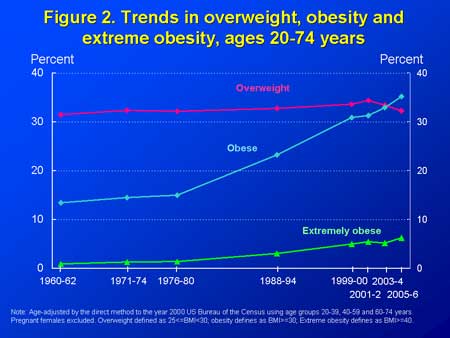
CDC says obesity is on the rise show, obesity is on the rise (so is our population, but again, we’re putting aside that argument). So the big question is: why? Why are people getting fatter? Well, let’s take a look at that chart up there. Something had to have happened somewhere in 1976-1980 to cause our waistlines to expand. What was it? Well, I’d like to start with this link: https://www.nal.usda.gov/fnic/history/index.html In this link, we can see the food guides being put out by the United States Government starting in 1894. Granted, some of these are difficult to see, but pay special attention to this picture:
www.nal.usda.gov/fnic/history/8558v.gif The one on the far left of the screen is the dietary guidelines from 1980. As far as I can tell from my research, this is the first time the federal government warns against “too much fat, saturated fat, and cholesterol.” Before this time frame, the official stance on eating was to eat a “balanced” diet; one in which grains, dairy, meat, and vegetation were all consumed in the same quantities. Old Government Suggested Servings Here’s where the really interesting part comes in. A serving size has remained pretty much the same, however, we have gone from eating 2 servings of bread, 2 servings of milk, two servings of meat, and two servings of vegetables to eating double the amount of bread, and double the amount of milk. Now the “Food Guide Pyramid” would have us eating 6-11 servings of grain, and yet the same amount of vegetables, fruit, nuts, dairy, and meat as always. (see this link) So, since 1979 we have increased our grain consumption from 2 servings a day to 11 servings a day, and our recommended servings of everything else has stayed the same. Interesting, isn’t it, that at the time that grain consumption began to rise, so did our waistlines. Let’s dig deeper into this. Here’s a graph showing the consumption of meat since 1960: US Meat Consumption since 1960 and grain consumption increased by 45%. (see this link) The trends can be seen even more dramatically here: (see this link) And so, what are the conclusions? Well, obesity began to rise around 1970. Also around 1970, the United States Federal government began officially supporting the position of eating more grains. I don’t think this proves that eating grains makes you fat, but it is awfully interesting. So let’s look a little bit closer at the why. Our question is now: why does the United States government want its citizens to eat grain.

The first answer is the most common. It’s what most people on the street will tell you. It’s what the chefs on TV say. It’s what your doctor [1] will say. It’s what the federal government will say. The answer that is most common is: “Eating heart healthy whole grains lowers your risk of diabetes, stroke, and heart disease, while eating artery-clogging saturated fat leads to high blood cholesterol, heart disease, and strokes. Eating a diet high in fat also leads to gaining weight, while a diet in whole grains will make you feel full longer, and lead to weight loss.” These statements have their roots in a study done by Ancel Keys. Ancel Keys, and other “scientists” convinced a panel of federal government goons that animal fats were the problem, and grains and vegetable oils were the solution. You can watch more about this here: Big Fat Lies and here: Why You Got Fat

So, if “heart healthy” whole grains are bad, and they are proven time and time again that they are, and “artery clogging saturated fat” is good, and it’s been proven again and again that it is, then why does the federal government push grains so much? We’ve removed the “health” answer, so now we’re back to the question: why does the United States government want its citizens to eat grain?

Well, let’s explore the crazy tin foil hat theory (sorry dad, aluminum foil hat). Maybe the federal government knows that grains lead to heart disease, diabetes, and obesity. Maybe they want their youth to be hopped up on sugar highs and lows all day. Maybe they want their population to be obsessed with dieting and health issues. Maybe they want a fat, slow, stupid population. Maybe we’re all just cattle, being fattened for the slaughter.

I don’t buy it. I just don’t think our government is that intelligent. No, I think it’s far more likely that a simple answer is in order. Greed. As the movie Fat Head [Archived film listing.] points out, if you want the answer, you have to follow the money. Who were the people and organizations that pushed this theory? Fat Head would have you believe that it is the vegetarians (Fat Head movie segment). That’s a plausible theory, but I have a different one. Let me ask you a question. If you had a business that made drugs that “treated” high cholesterol and obesity, would you: A) want people to be less obese and with low cholesterol OR B) want people to have MORE obesity and high cholesterol? Oh, and what group lobbies the most in Washington? One more piece of damning evidence: the group of drugs called statins. Statins lower cholesterol and Merck began to show interest in the Japanese research of statins in 1976.

So we have a group of companies who lobby the government the most. They began to show interest in a drug that lowers cholesterol. A few years later, the federal government ignored valid scientific studies proving that grains cause diabetes and high blood cholesterol, embraced pseudo-science and began its “whole grains” campaign. As it turns out, that made Americans fat and full of high cholesterol. Which led to doctors prescribing statins.

I’m not making this stuff up. It’s all right there on the internet. Go look up the facts. Then go eat some bacon.

Coyote Vick
2011
Coyote Vick is a staff writer at Bad Quaker Dot Com
More by Coyote Vick can be found at crapimanadult.blogspot.com

[1] footnote:
[1] Incidentally, it must be should that while your doctor might make dietary recommendations, they often do so without ever having received any nutritional education. Doctors are not, in fact, required to take any nutrition courses to become doctors. So the notion of your doctor being an “expert” in nutrition is in fact, false. Your doctor knows as much about nutrition as you do.

Posted in Health, History, The Campfire | Tagged , , , , , , , , , , | 1 Comment

Some thoughts expressed by Robert Higgs

Recently Robert Higgs expressed some thoughts on his Facebook page. We at Bad Quaker recognize Robert Higgs as a primary leader in the liberty movement and felt his casual words should have as wide an audience as possible.

Robert Higgs:

I’ve made a lot of mistakes, but one mistake I’ve never made, and never will make, is to give money to a politician. Nor, if I had been a passenger on one of the trains robbed by Jesse James and his gang in the 1870s, would I have seized the opportunity to make a voluntary donation to the robbers.

I think it’s important to recognize that silent withdrawal of allegiance from the state, although it may seem to be, and in a literal sense is, nothing, may yet prove to be the most decisive “action” in the end. When people act …overtly against the state, if their action truly threatens the state, the state comes down on them hard and violently. At the same time, it characterizes them as outlaws and troublemakers (terrorists, nowadays) and encourages the bovine masses to rise up in support of crushing them. Often this whole cycle of challenge and response accomplishes nothing but the creation of martyrs. In contrast, silent withdrawal, stealthy sabotage, well-concealed disrespect and opposition in a thousand different forms, can eat the heart out of the popular acquiescence the state requires to persist and function effectively. Something like this happened in the USSR. No bloodbaths, yet the destruction of a truly horrible apparatus of tyranny. (The tragedy there is that the people had no vision of a genuinely free society to establish once the old regime had fallen, so instead of freedom they ended up with merely a milder form of authoritarianism.)

Robert Higgs is an economic historian, Austrian economist, and a libertarian anarchist. He is a respected author in the field of economics and economic history.

Please see his page at The Independent Institute

Posted in Brief Articles and Short Notes, Free Society, History, Voluntaryism and Social Interactions | Tagged , , , , , , , , , | 1 Comment

Jesus as an Anarchist

Jesus as an Anarchist
by Ben Stone
(audio article)

Could Jesus be classified as an anarchist, specifically an anarcho-capitalist? For the purpose of this article, we’re not referring to Jesus’ view on government or lack there of. We’re strictly examining Jesus’ teaching of the Golden Rule as compared to the anarchist Zero Aggression Principal. Anarcho-capitalism is founded on the Zero Aggression Principal and it in turn is founded on property rights. (I’ll cover property rights separately)

“The Zero Aggression Principle (non-aggression axiom, non-aggression principle, ZAP, NAP) is an ethical stance which asserts that “aggression” is inherently illegitimate. “Aggression” is defined as the “initiation” of physical force against persons or property, the threat of such, or fraud upon persons or their property. In contrast to pacifism, the non-aggression principle allows violent self-defense of person and property. The principle is a deontological (or rule-based) ethical stance.”

Jesus wrapped up his teaching quite well when he said, “All things therefore whatsoever ye would that men should do unto you, even so do ye also unto them: for this is the law and the prophets.”
So Jesus states the famous Golden Rule then states that the entire “law and prophets” is summed up in this rule.
The Golden Rule is a simple summery of the ZAP. The two are identical in both philosophy and in practical outworking. If a man follows the Golden Rule he will be following the ZAP. And if a man follows the ZAP he will be following the Golden Rule. The Law and the Prophets are the meat and potatoes of the Old Testament and Christ’s message and sacrifice are the purposes of the New Testament. If the Golden Rule is central to the message of the New Testament and fulfillment of the Old, and the ZAP is the same as the Golden Rule, then the ZAP is one of the central messages of the Bible.

Property Rights and Economics
Who owns what?
Anarcho-capitalists believe in “self ownership”.
We assume for this discussion, that God created the heavens and the Earth and all they contain. But God didn’t create them so he could posses them. That would be completely illogical since God would have the unlimited ability to create billions of universes if he only sought to posses them. God’s actions were purposeful. Survival Gear Bags When God created humans he gave them something that stands out in the animal kingdom, free will. That means that even though the source of man is God, man owns himself. He can chose to accept, reject, or ignore God. The book of Genesis gives us several accounts of the Biblical concept of property rights, but at the end of Chapter 1 God clearly states that God grants mankind complete ownership of the creation with the exception that he must go forth and subdue and fill it. Anarcho-capitalists call this Lockean Homesteading or the Lockean Proviso. Adam was even given the responsibility of naming each thing in the creation, and having the right to name an item is one sign of ownership. So we have life, self-ownership, and homesteading rights over the entire creation given to mankind as a gift. And God offers us eternal life through the gift of His sacrifice. Anarcho-capitalists recognize gift giving as one of the three legitimate ways to own property, along with homesteading and voluntary exchange. Anarcho-capitalists believe that when humans freely choose to act in the production, exchange, and consumption of property and services, we have a right to do these things so long as we do so within the boundaries of the ZAP. So what we have seen here shows that the ethics of anarcho-capitalism was central to Jesus’ teaching, and it is the economic method God uses to produce and distribute goods and services.

Ben Stone
2011

Posted in Bad Quaker Theology, Brief Articles and Short Notes, Free Society, History, Voluntaryism and Social Interactions, Voluntaryism and the Zero Aggression Principle | Tagged , , , , , , , , , , , , , | 1 Comment

Weekend Post

Abe Lincoln was a murderous racist pig and the majority of the magical myth that surrounds his legend is based on lies.

I will say then that I am not, nor ever have been in favor of bringing about in any way the social and political equality of the white and black races, that I am not nor ever have been in favor of making voters or jurors of negroes, nor of qualifying them to hold office, nor to intermarry with white people; and I will say in addition to this that there is a physical difference between the white and black races which I believe will forever forbid the two races living together on terms of social and political equality. And inasmuch as they cannot so live, while they do remain together there must be the position of superior and inferior, and I as much as any other man am in favor of having the superior position assigned to the white race.

~ Abraham Lincoln, Debate with Stephen Douglas, Sept. 18, 1858, in Abraham Lincoln: Speeches and Writings, 1832-1858 (New York: Library of America, 1989), pp. 636-637.

True Fact: Abraham Lincoln was one of Adolf Hitler’s favorite Americans.

~ Staff post: Bad Quaker

2011

Posted in Brief Articles and Short Notes, History, The Campfire | Comments Off on Weekend Post

Why Must The State Forbid The Duel

The Duel
(audio version at bottom of page)

Before progressing, let us establish exactly what is and is not meant by the word “duel” for the purpose of this article. A duel is not a drunken fistfight. Nor is it to be confused with a trial by combat, although that would make a delightful subject to explore. As well, a duel, for our purposes here, is not the military clash of champions as in David/Goliath or Achilles/Hector.

We are referring here to the settling of a private dispute between two individuals. Private, meaning that for whatever reason, this dispute is taken to a neutral area and only viewed by individuals selected by the combatants as representatives or “seconds”, attending the needs of and representing the combatants, and/or by those selected as witnesses. This form of duel comes to us in Western Culture from the ancient tradition expressed in the Scandinavian word holmgang, however it was by no means unique to northern Europe. The duel, then, being private combat executed by adults under prearranged circumstances and following agreed terms, for the purpose of permanently settling a private dispute. Survival Gear Bags Duels were often staged on a river island or in a remote field. The seconds would arrange the place, time, style of combat, and conditions for settlement. Weapons, if used, would be available for inspection by the combatants and the seconds prior to the contest. Usually the combatants were the primary parties involved, but under some circumstances one or more of the primaries were represented in combat by a stand-in. Combat would commence upon signal and all combat would cease when an agreed stage had been reached, such as first to lose footing, first to draw blood, first to surrender, or on rare occasions, death. It should be emphasized here that death was rarely the goal of the duel. Upon completion of the duel the original matter of contention was considered settled and could not be appealed or revisited. The rules, conditions, and settlement of the duel were based on the honor of the participants and enforced by voluntary social contract. In other words, if someone cheated or reneged the witnesses were expected to expose the cheater and the community would shun that dishonored person in the manner of their customs. The duel, in its varying local forms, has been the basic method for honorable people to settle their private disputes from prehistory until the adoption of the modern state one hundred to two hundred years ago.

The duel had a variety of advantages in providing justice over other socialized measures. For example, as mentioned, it was private. No unnecessary information needed to be spread around the community and private or possibly embarrassing or perhaps family specific information could remain private. There was no need for police to investigate with their prying questions and intrusive searches. There was no reason to involve a judge or for a jury to hear your private information, and there were no attorneys to drag out facts, ask embarrassing questions, or badger someone into saying something publicly that they preferred to keep private. In addition to privacy concerns, by eliminating the police, investigators, judge, jury, and attorneys you eliminate the monetary cost of justice to the individuals and you eliminate the opportunity for one party to simply buy justice. Also, since this form of justice had no or very little cost it was available to rich or poor without being a burden on uninterested third parties by way of taxation. So then, the duel was an aspect of free market justice rather than socialized justice. Of course, the duel was not the answer for every dispute. As noted above, it had very narrow applications. But within the scope of its limitations, the duel provided a way to address grievances that no socialist based justice system can serve.

Advantages To The Duel

1) Cost

As mentioned above, a private matter settled privately, with the limited cost paid by the interested parties, is vastly cheaper than involving the hordes of tax feeders that come with socialized law.

2) Justice, without regard to individual position in life

The State’s statue representing “Blind Justice” would be a sad joke if not for the State’s devastating effect on the lives of humans. I find it unnecessary to prove that State justice is based almost entirely on the social position of the accused and the social position of the accuser. This is so obvious that I will assume the point need not be labored. The duel, properly executed, is truly blind to social standing, family position, titles of honor, physical hardship, and net worth since the duel itself can be anything from physical combat to a quiet game of chess. An example of this fact was the very first duel recorded on American soil, just one year after the Puritans landed. Two bondservants dueled over a private matter using swords. Both men received minor injuries and the matter was closed.

3) Vengeance and the desire to avenge is deferred to honor

If two parties have a conflict, any solution provided by a third party utilizing force to inflict that solution cannot be satisfactory to both the conflicting parties and will leave at least one party vengeful. Since a satisfactory solution cannot be achieved, the conflict will continue no matter the force applied. If, on the other hand, the two conflicting parties agree on the terms of the duel, to object to the outcome after the duel is to admit dishonesty and therefore dishonor. So honor trumps vengeance in a properly administered duel.

What if I am wrong? What if the duel is less efficient, less equitable, and less successful at providing justice? What if every possible aspect of the duel were to be argued here in this article and the conclusion were clear that the duel fails in every practical way when compared to the socialized justice of the State? What then?

The conclusion I would draw is that the State and its socialized systems are still immoral and any system based on immorality cannot produce justice. Therefore the duel is at least as good as the State even if it fails in its intended purposes.

But the question at hand is, “Why Must The State Forbid The Duel”

The word “sovereign” comes from the Latin for Super Reign and can literally indicate deistic qualities.
The existence of the duel in society in any form, used to garner justice in a private matter, threatens the sovereignty of the State. The State is a man made god, requiring unblinking faith in the central myth of its necessity to society. The State feigns omniscience, seeks omnipresence and lusts for omnipotence. The State demands that its plans and schemes be secret, but requires its subjects to reveal the most private aspects of their lives to it. If any individual has the right to true privacy then the sovereignty of the State’s right to that information comes into question. If two people can share private information regarding a conflict and settle that conflict entirely in private, the State cannot feign omniscience nor can it claim omnipresence. The duel by its very existence proves that justice can be privately achieved by honor without the boot of the State. Therefore when two people settle a conflict through duel the myth of the sovereignty of the State vanishes.

For this reason, the State could never come to full fruition as long as the duel existed. Many people mark the mid 1600’s as a turning point in the maturity of the State, and I would agree. But among other things, the continuing practice of the duel prevented the State from taking its godly seat as Provider of Justice. In the United States the duel faded from society about the same time Progressive politics, the Temperance Movement and government schools became all the rage. In Japan the duel and the tradition of honor it represented ceased with the Satsuma rebellion in 1877. In Russia, it died with the Tsar and his family. In a final tip of the hat to the duel, the renowned field marshal Günther von Kluge challenged general Heinz Guderian, father of the Blitzkrieg, to a duel. But alas Hitler forbid it.


Ben StoneBen
2011

Why Must The State Forbid The Duel

Posted in Audio Articles, Bad Quaker and the Constitution of The United States, Free Society, History, Voluntaryism and Competitive Government, Voluntaryism and Law, Voluntaryism and Social Interactions | Tagged , , , , , , , , , , , , , , , , , , , , , , , , , , , , , , , , , , | 2 Comments

One Difference Between Conservative, Liberal, and Libertarian

These are confusing times for label makers and label takers. In the 1980’s defining a conservative or a liberal seemed fairly easy. All one had to do was point at Ronald Reagan and ask, “Love him or hate him?” Not at all a difficult task. But for some who were looking very closely at the workings of DC in those days, defining a conservative was confusing at best and impossible at worst. Reagan’s takeover of the Republican Party and seemingly the political Right along with his vast non-Republican support appeared to signal a conservative victory in the war of political philosophy. When conservatives and libertarians heard Ronald Reagan say, “In this present crisis, government is not the solution to our problem. Government is the problem!” and when we heard, “This is the issue of this election; Whether we believe in our capacity for self government or whether we abandon the American Revolution and confess that a little intellectual elite in a far distant capital can plan our lives for us better than we can plan them ourselves.” these words stirred the heart of every liberty loving American. But there was a cancerous flaw in the Reagan Revolution. Because of this flaw, the more carefully you look at the goings on in DC from 1980 till 1988, the fuzzier the definition of conservative gets.

For the Reagan Revolution, its death began before its birth. Today, few remember the hard primary fight Reagan had against his opponents George H. W. Bush, Howard Baker, John Connally, Bob Dole, and others (all hard core Right Wing statists). Few remember the harsh hateful words that Bush would throw around at fundraisers and at stump speeches accusing Reagan of holding all kinds of crazy extremist positions. Few remember how Reagan nobly refused to sling mud at his fellow Republicans no matter how vile they became. And fewer still realize that Reagan’s winning of the Republican primary in 1980 was anything but a lock. The national convention was sewn up before it began, but the individual state conventions were politics at their worst. In the gap between the state conventions and the national convention, deals were offered and promises were made. The Old Right of the party finally gave Reagan a choice. Take Ford as VP and appoint Henry Kissinger as Secretary of State and Alan Greenspan as Secretary of the Treasury, or take Bush as VP and appoint his crew to the positions. Otherwise face a fight at the national convention. Reagan compromised his principals and accepted the lesser of evils. With that, the Reagan Revolution drank its hemlock before it cleared the birth canal.

Of course everyone spoke the conservative words of the Revolution, and some taxes were cut. The economy did recover by way of the typical bubble making process, so well known to those in the Austrian School of Economics, but leviathan government grew at speeds never seen in a generation. DC essentially whipped out its massive credit card and bought a few years of prosperity. When the next bust cycle hit, the Republican’s were discredited and a half liberal womanizing redneck was able to point his finger and say, “Its the economy, stupid!” all the way to the White House. In those years the Old Right of the Republican Party entrenched its self, but with a new tool. The Old Right learned that if they spoke the conservative talk, they could go back to their compromising ways and work with the Democrats and none would be the wiser. And thus they did until 2008 when the nation completed the task of tossing the bums out of power.

This left a very confused body of faithful conservatives. Many asked themselves who they were and to what label did they belong? The word “conservative” had been so completely polluted by the right wing statists that its meaning was almost completely lost. Old time conservatives were never afraid of a fight, but were never warmongers. They always insisted on fiscal responsibility and were abhorred by national debt. How could the word conservative now mean endless war, welfare expansions in Medicare, warrantless searches, forced national IDs, massive federal intrusion into local schools, and government agencies created for the sole purpose of spying on American citizens? Conservatives began looking around and they spotted a curiosity. Their old allies, the libertarians, had clean hands. Conservatives began to ask themselves, “Maybe I’m a libertarian after all.” But they were wrong.

Often times its hard to tell who is a liberal, who is a conservative, and who is a libertarian, and who is none of the above but is a pure statist willing to sell anyone down the road for more power. The media, in its true evil nature, propagates the lies of the statists by focusing on the so-called “Hot Button Issues” while pretending that statists don’t exist. The fact is, these “Hot Button Issues” are very important, but can easily be resolved using libertarian principals rather than choosing to believe the media lies and trust the State for the answer.

For example, the quickest way for the media to discredit a libertarian is to bring up the drug issue. Some conservatives and some liberals will side with the libertarians in the fact that the War on Drugs is a dismal failure and a massive waste of time, money, and resources. Its not hard to point to the prison system and say, “All the king’s horses and all the king’s men can’t keep drugs out of prisons, much less schools!” Or just consider how difficult it is for a 14 year old kid to buy a bottle of Jack Daniel’s compared to a bag of pot? Of course, a bag of pot is easy for a 14 year old to buy. Survival Gear Bags That bottle of Jack is almost impossible! Funny how prohibition and black markets work, isn’t it? But unfortunately the cries of the bleeding hearts and the confused sheep win the day when whipped into frenzy by the media and the statists howling the threats and spreading the fear that America would suddenly be overwhelmed by crazed drug fiends prowling the streets raping and pillaging, if it were made legal. Facts don’t matter when the media is involved. Only hype makes viewers stare at the stupid-tube.

Ah, but the subtlety of difference was missed in the above paragraph. Notice that some liberals and some conservatives sided with the libertarians. They did so for practical reasons. A basic understanding of economics allows one to quickly see that outlawing anything creates a black market for it, thereby driving the price up dramatically and creating a money making tool for criminals. But here the difference is missed yet again. These liberals and conservatives can clearly see the practical reason, but miss the moral reason altogether. The consistent libertarians don’t reject the War on Drugs because its impractical, they reject it because of their understanding of property rights and the proper function of government. And the statist doesn’t seek to perpetuate the War on Drugs because he thinks it’s winnable or because it’s his moral duty to tell people how to live their lives. He perpetuates the War on Drugs because it increases the power of the State!

The liberal and the conservative tend to look at the immediate cause and effect and support what they think will provide good results now. The consistent libertarian judges by a different scale. The libertarian philosophy is based on an understanding of natural law, property rights, and responsibilities. As the libertarian applies these natural law principals to each and every aspect of life it becomes easier and easier to understand how to live a moral life and how all of society can become free, peaceful, and prosperous. The libertarian doesn’t seek to solve every individual problem in society because the philosophy of natural law will, by way of the “invisible hand” that Adam Smith wrote of, guide society to a solution as long as that society follows natural law.

The statist will insist that only a powerful State can solve problems! The libertarian understands that to give any issue into the hands of the State will both increase the problem and increase the power of the State to further invade peaceful society. The libertarian understands that most if not all problems are caused by the State to begin with, and more State is not the cure. It’s simply sugar-coated steps to slavery.

So the difference between the conservative, the liberal, and the libertarian boil down to two things. One is the libertarian trust in natural law, and the other is the ultimate dependence on the State by liberals and conservatives. The libertarian believes individual issues like abortion, gun control, deficit spending, taxes, gay marriage, welfare, drugs, and even war its self; all fade away with legitimate government and the abolition of the State. But as long as liberals and conservatives allow the media and the statists in the two parties to use the “Hot Buttons” to keep them focused on fighting each other, they will never open their eyes to the two massive leaches that have attached themselves to America’s jugular veins interrupting the flow of blood from America’s head to its heart. One Republican leach on the right jugular and one Democrat leach on the left jugular, draining the American people of their wealth, their morals, and their children’s future.

Ben Stone
2010

Posted in Free Society, History, Liberals and Conservatives | Tagged , , , , , , , , , , , | 1 Comment

State, Society, and Government

State, Society, and Government
by Ben Stone
(audio article)

As has been noted by others, people have a tendency to confuse society and/or government with the State. In discussions of freedom, this is a point of confusion that often ends in a person proclaiming something idiotic like, “You want to abolish laws!” or “You believe in a fantasy world where everyone is good!” or the laughable, “Who’s going to save you when the criminals break down your door and there’s no cops to call!”
For now, let’s set aside the obvious retort, “When seconds matter the police are 8 to 12 minutes away.” or my favorite, “If someone is breaking down my door I’ll only need the cops for body removal and insurance forms.”

State:
The State is an entity made up of a collection of individuals who utilize force, theft, and fraud in an attempt to maintain a monopoly of violence within a geographic boundary or national border. Individuals functioning as the State glean their income using what Franz Oppenheimer called “the political means” as opposed to people who use the free market in what Oppenheimer called “the economic means”. Another way of saying it is to refer to the tax feeders and the taxpayers. There are variations within these groups such as those who provide real services that the State has usurped, teachers, firefighters, police, courts, and other government positions but we will cover that later in the essay. Additionally there are those who are parasitic to both the State and the taxpayers, but again that’s for different essay. At this point lets just focus on the State as the collection of individuals using methods that, under any other circumstances would be considered criminal, in order to expand or maintain their monopoly of violence and income.

Society:
Society is a set of individuals with common bonds who develop and set norms of behavior within their group. For example, in some societies it’s considered ill mannered to eat with your left hand. Now at this point such restrictions wouldn’t be called laws but guidelines or standards of behavior. To violate them will bring consequences but without the State those consequences are limited. So then a person who eats with the wrong hand (for our example) may not be invited to dine with others or may be considered backward and not trusted or “dirty” and may be shunned. Perhaps a shopkeeper wouldn’t what them in his place of business or a potential mate could refuse to wed this backward savage. Having had our vision so fogged by living under a State, we often fail to understand how much power rests in the hands of society and how powerful a tool shunning can be. When taken to its logical conclusion, those who refuse to conform to society are generally exiled from that society. Yet in that exile also comes freedom from that society. The left-hander in our example can simply seek people more tolerant/intelligent.
When the State invades the functions of society an ugly manifestation occurs. Simple behavioral guidelines become regulations and then, when they fail, laws. So the uncouth diner goes from first being ticketed and fined, to eventually charged with crimes against the State and his left arm chopped off.
You say my example is extreme and unrealistic? Then consider the evolution of drunk driving laws in America. At first, if caught driving drunk you could expect to be escorted home or taken to the police station to sleep it off. As long as you hadn’t done any harm or damage, your behavior was simply frowned upon. Survival Gear Bags Now you can be stopped for absolutely no reason other than to see if you have been drinking. You can be tested for alcohol and you can be arrested even if you don’t show the slightest sign of impairment. You can actually be convicted for refusing to be tested and under the right circumstances and for repeat offenses, you can actually be imprisoned even though you may never have caused damages or harm to any person or their property.
All kinds of arguments can be made about keeping the roads safe or what have you, but none of those arguments can escape the glaring fact that you can be arrested, fined, punished, imprisoned, and if you resist, killed for a “crime” where no person or property were harmed. Additionally people who had nothing to do with your “crime” will be robbed (taxed) at the point of a gun to pay for this “enforcement” whether they agree with it nor not.
A free society has an abundance of tools to deal with harmful or unacceptable behavior but the State only has one. The iron fist is the answer to every question asked of the State.
Just for giggles, consider the coming terror of our age: Texting while driving. The drunk driving of tomorrow! What will be the eventual reaction of the State when people continue texting?

Government:
It has often been said that the government which governs least governs best. (And by “govern” I use the old definition of the term: to keep things normal or steady while providing for basic security) I don’t categorically disagree with that statement as far it’s generally intended to go, but I find it lacking in several areas. For example, if you’ve been harmed by a thief to the extent of the loss of $100 and you entrust your government to provide justice and remedy that harm, a government that only recovers $20 may be governing the least yet surely lacking in its role in bringing justice. Or, lets say an invading army marches across your land, burns 80% of your farm and consumes 80% of your stored goods. You would hardly be satisfied with a minimalist government that only protected you by a margin of 20%, now would you? So lets talk about what we should expect from a government.
A government should first and foremost, protect us from foreign aggressors. If a government fails at this task it hardly matters what other task it may accomplish. Of course we must define a foreign aggressor before we can check our government’s performance. The word “foreign” could mean “strange” but when used in this context it’s better defined as an aggressor from a different geographical area and/or society. Likewise, a government must be able to protect us from domestic aggressors, those near us and within our society. So protection of the individual and the individual’s property should be the highest priority of a government. Protection from aggressors goes hand in hand with dispute resolution and justice. If government is charged with protecting individuals and their property then government must have a means of determining whom the aggressor is and what must be done to bring justice.
Time has proven that government serves efficiently in the capacity of standardized weights and measures. Businesses can and has done this on their own on a local scale, but government has the advantage of being able to make agreements with other governments thereby providing a larger market for business than would otherwise exist.
Government must be somehow funded, otherwise its incapable of hiring individuals to accomplish the tasks required of it.
Lastly government must be subject to some form of governance. In other words, if individuals need a government for the reasons listed above and that government is made up of individuals, then by its very nature government needs governance because it is simply a collection of individuals.
Throughout the ages, mankind has experimented with a variety of models of government with a wide range of results. Many, but not all of those experiments ended up with the government being supplanted by the State and eventually a failure of the State causing a failure of the government, and usually the society. The most notable examples of these failures are easy to spot because of one of the great characteristic of the State. Namely, State propaganda, or as it’s better known as, written history. Most of us know about governments that were supplanted by the State and latter collapsed. We could name a few here, such as ancient Egypt, Persia, Greece, and Rome, or we could point to Central America in pre-Columbian times. But lacking the propaganda of the State, few of us think about Stateless governments that lasted many thousands of years longer among the Gaelic, Celtic, Germanic, and other so call barbarians across northern and eastern Europe, the Steppes and even Australia, Sub-Saharan Africa, and North America. Without a State, many people maintained successful governments that protected and nurtured rich societies, bringing us from squatting under trees and rock overhangs through the Stone Age and almost to the modern age. The majority of Medieval Europe including some large cities and many towns and villages remained Stateless or virtually Stateless for most of their history and some areas were able to limit the encroachment of the State right up to the beginning of the Twentieth Century.
Medieval Europe wasn’t exactly a libertarian utopia, but at its worst, large groups of people lived with no tax burden at all and if some local Duke or Prince became oppressive the average person could simply pack up their wagons and move to a freer town, city, or region. Try that today without the State’s permission.  Try packing up your belongings in Rybnik Poland and hiking across the valley and over the hill to Ostrava, in the Czech Republic. Or better yet, try moving your family from Juarez Mexico to El Paso Texas without the blessings of the State.
The governments of the American Colonies, as documented by Murray Rothbard in his masterful work Conceived In Liberty, were largely Stateless up until after the French and Indian War when England attempted to pay its bloated war debt by robbing the wealth of the colonists. Even then the son of an immigrant Ulster Scot, having lived his entire life in Appalachia could grow a field of corn, harvest it, turn it into whisky, barrel it, transport it to a city, and sell or trade it without paying one penny of tax or asking the permission of one bureaucrat. Much of Appalachia was Stateless and governed by its clans from the 1660’s well into the 1800’s, with its own distinct culture, laws, courts, roads, and contracts while surrounded by what could only be considered “hostiles” to its west as well as south and east. Twice, invading armies attempted to move through Appalachia and were soundly rebuffed by voluntary militia. One of those times was when Appalachians spontaneously united to stop a British force under Patrick Ferguson by soundly defeating and killing him at the Battle of King’s Mountain, the false history of which is a perfect example of how the State lies to justify itself. The other time was the Whisky Rebellion; an event equally lied about by the State, when some 500 Appalachians put the taxman in his place. Washington wisely avoided the mountain folk and their militia while parading his forces up and down the low country and proclaiming victory, a tactic he perfected during the War of Independence. Staying out of the Appalachian hill country at that time may have been the single smartest thing Washington did in his entire life.

Having said all of the above on the topic of government, I would like to point out three things.

  1. None of the above precludes more than one government functioning in the same geographical region as long as that government is not polluted by a State.
  2. None of the above requires a government to initiated force on an individual or any other government as long as that government is not polluted by a State.
  3. None of the above prevents an individual’s involvement with a government from being on a strictly voluntary basis if that government is not polluted by a State.

So then we can see that a free society can have a government, and that government need not be in the clutches of the State.

Ben Stone Ben
2011

Posted in Free Society, History, Voluntaryism and Competitive Government, Voluntaryism and Law, Voluntaryism and Social Interactions, Voluntaryism and the Zero Aggression Principle | Tagged , , , , , , , , , , , , , , , , , , , , , , , , , , , , , , , , , , , , , , , , , , , , | 1 Comment